Appendix
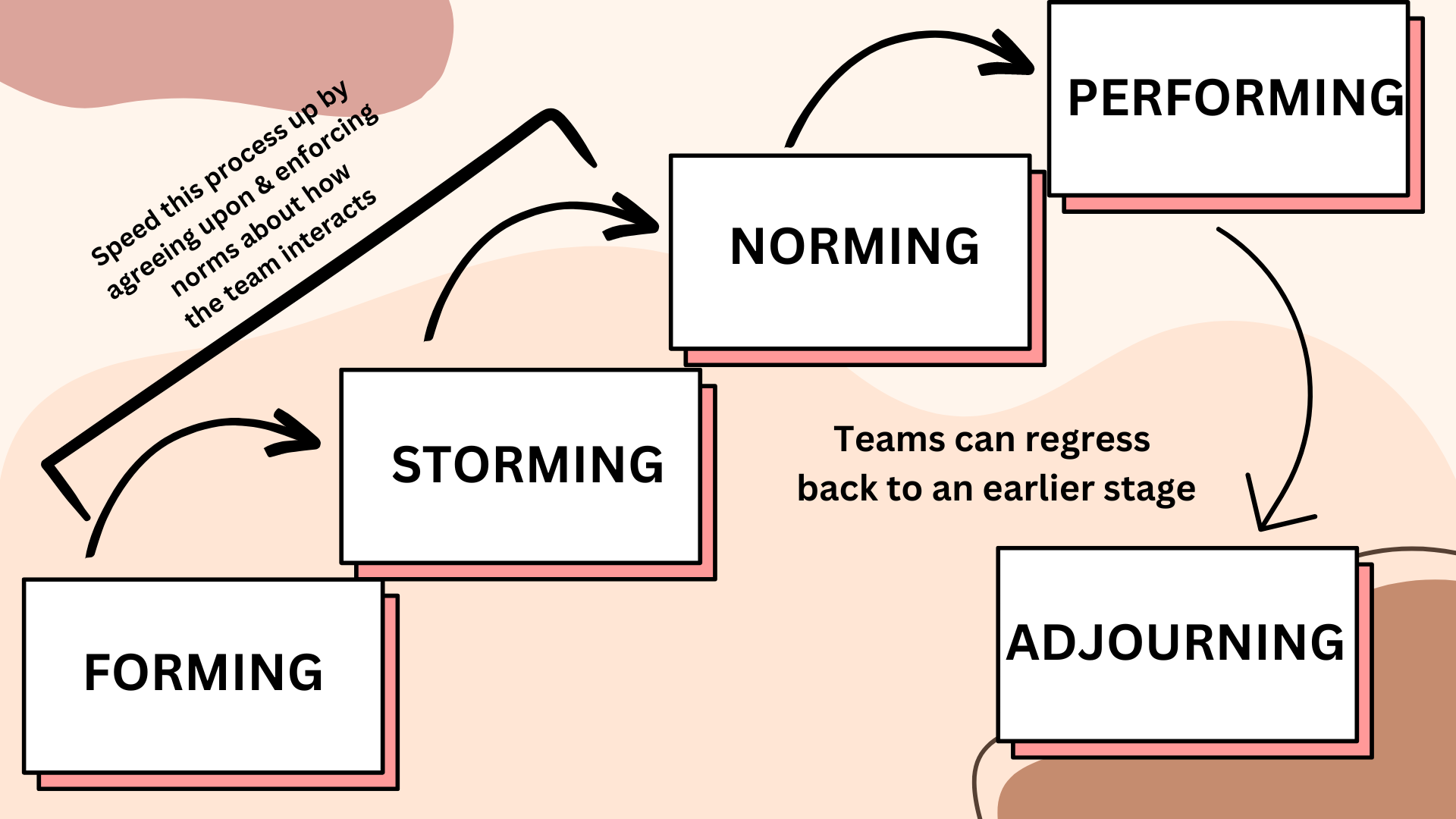
Teamwork plays a vital role in organisations, enabling individuals to come together and achieve shared goals (Deloitte, 2016). Understanding the dynamics and stages of teamwork is crucial for optimising team performance. Tuckman's model provides a valuable framework for understanding the journey of teamwork (Figure 1) (Stein, 2023). By recognizing and embracing the stages of forming, storming, norming and performing this will aid teams to establish relationships, resolve conflicts, evaluate goals and values and leverage synergy and productivity to result in a successful team outcome (Newman & Ford, 2020; Stein, 2023). Nevertheless, it is crucial to acknowledge that the progression of team development is not always a straightforward path (Stein, 2023). Teams may experience setbacks or encounter unexpected challenges that demand flexibility and adaptation (Clark, 2020). Additionally, Tuckman's model does not encompass all facets of teamwork, including external influences and the impact of leadership styles (Stein, 2023). Nonetheless, by utilising Tuckman's model as a framework, teams can establish a solid basis for success, enhance their performance, and ultimately attain superior results while cultivating a constructive and efficient work atmosphere.
The global pandemic had a tremendous impact on today’s teams where it became more complex. Teamwork underwent a transformation to adapt to the challenges presented in the post-Covid era, including the significant shift to remote work experienced by organisations. This shift necessitated the essentiality of virtual teamwork (Clark, 2020). This has increased reliance on digital communication platforms such as Zoom that played a crucial role in facilitating team communication to maintain productivity and connectivity (Clark, 2020). However, this has led to decreased meaningful social interaction and difficulties in building rapport and trust among individuals (Wildman et al., 2021). Therefore, organisations have been compelled to tackle these challenges by implementing strategies that encourage virtual team building, foster a sense of belonging, and alleviate feelings of isolation (Wildman et al., 2021).
Trends in teamwork are continuously difficult to understand due to its changing nature that is now more increasingly global (dispersed), virtual (digital) and project-driven (dynamic) (Haas & Mortensen , 2016). Despite this, teamwork is still established on the fundamentals of team collaboration (Wildman et al., 2021). Hence, teams thrive when certain conditions are met, including having a clear and compelling direction, a robust and well-defined structure, a supportive context, and a shared mindset among team members (Haas & Mortensen , 2016). Thus, cross-functional collaboration gained importance in addressing complex workplace challenges, allowing diverse individuals from various departments to contribute to a more holistic approach (Wildman et al., 2021). Consequently, the post-Covid era called for the development of new skills such as digital literacy and adaptability to ensure effective communication and collaboration amongst teams (Clark, 2020).
As I aspire to become a business development manager, it is crucial for me to possess a deep understanding of the strengths, weaknesses and behaviours of my team members. This will help me navigate in the stages of team development, particularly in the intricate landscape of post-Covid teamwork. The emerging trends in teamwork following the pandemic have provided me with valuable insights on how to adapt to the ever-evolving business landscape. Therefore, cultivating adaptability and resilience within myself will be instrumental in effectively managing my team and enhancing their performance during challenging times. Striking a balance between task-oriented behaviour and people-oriented behaviour will enable me to set clear goals and foster strong relationships with my team members. Moreover, it will empower me to establish a culture of constructive feedback, thereby fostering a more collaborative and efficient work environment. By embracing these principles, I can effectively lead my team towards success in the dynamic post-Covid business world.
Clark, T. R. (2020, March 24). 8 ways to manage your team while social distancing. Harvard Business Review; Harvard Business School. https://hbr.org/2020/03/8-ways-to-
manage-your-team-while-social-distancing
Deloitte. (2016). Global human capital trends 2016 the new organization: Different by design. Deloitte University Press. https://www2.deloitte.com/content/dam/Deloitte/global/Documents/HumanCapital/g
x-dup-global-human-capital-trends-2016.pdf
Haas, M., & Mortensen , M. (2016). The secrets of great teamwork. Harvard Business Review. Harvard Business School. https://hbr.org/2016/06/the-secrets-of-great-
teamworkNewman
S. A., & Ford, R. C. (2020). Five steps to leading your team in the virtual COVID-19 workplace. Organizational Dynamics, 50(1), 100802. Science Direct: Elsevier. https://doi.org/10.1016/j.orgdyn.2020.100802
Stein, J. (2023). Using the stages of team development. Https://Hr.mit.edu/; Massachusetts Institute of Technology. https://hr.mit.edu/learning-
topics/teams/articles/stages-developmentWildman
J. L., Nguyen, D. M., Duong, N. S., & Warren, C. (2021). Student teamwork during COVID-19: Challenges, changes, and consequences. Small Group Research, 52(2), 104649642098518. SAGE Publications. https://doi.org/10.1177%2F1046496420985185
